A ship goes where the wind lets it: its speed comes from its angle to the wind, the sail it carries and how its yards are braced, and getting the most from all three is the first skill of a captain.
The wind
The compass rose in the corner of the screen shows your ship, its yards and an arrow for the wind. The arrow points the way the wind blows, and the wind is named for where it comes from. In an engagement the wind holds steady from start to finish. In Corona del Mar it goes round with the clock, once every two hours of Greenwich time: from the north on each even hour, from the east at half past, from the south on the odd hour and from the west at half past that.
Points of sail
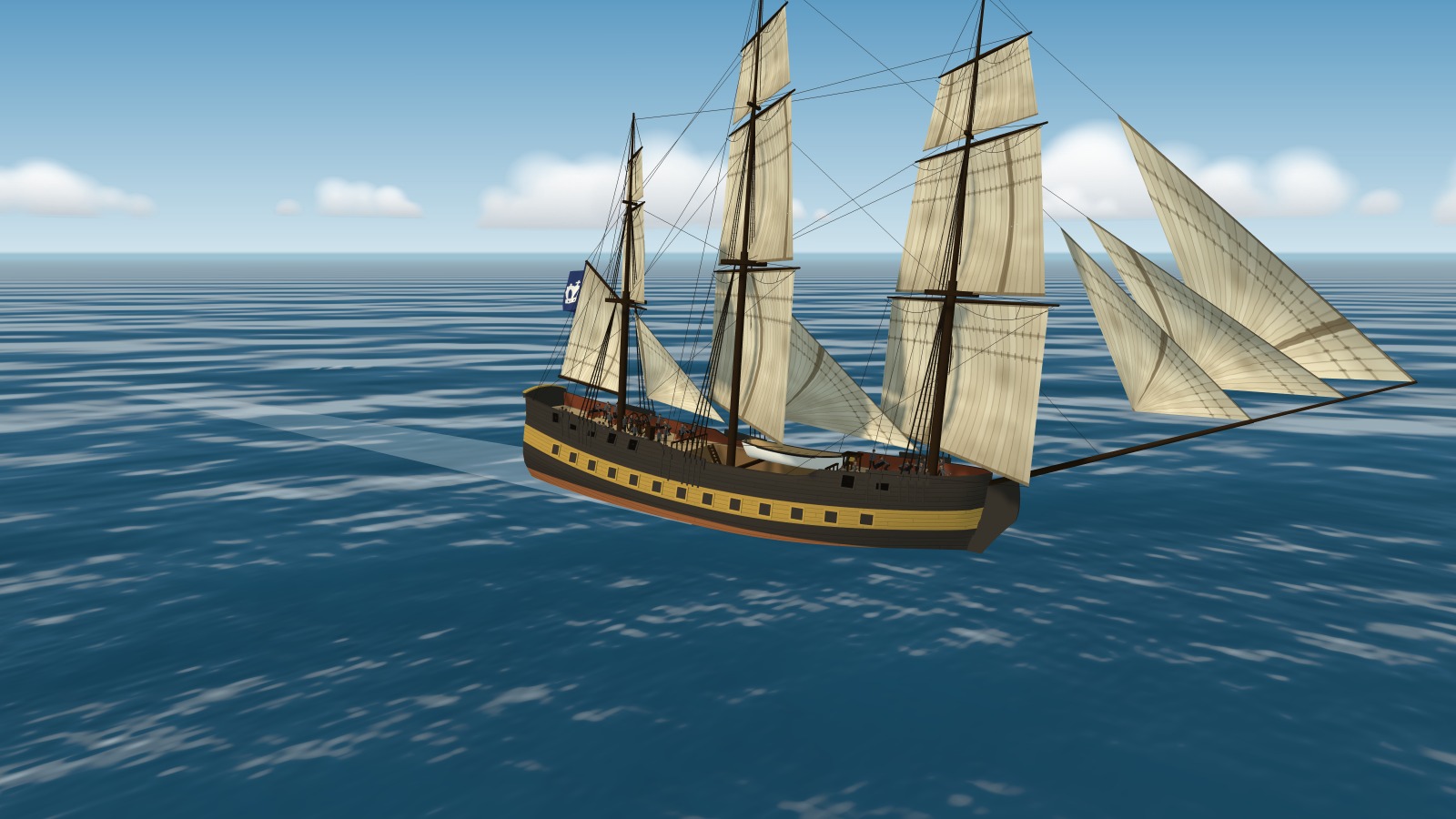
The angle between your bow and the wind sets how fast you can go. Every hull has its own curve, which you can see as a polar diagram on its shipyard page. Under full sail, with the staysails set and the yards trimmed, the hulls make these speeds in knots:
| Wind off the bow | 45° | 60° | 90° (beam) | 120° | 180° (dead astern) |
|---|---|---|---|---|---|
| First Rate | 3.0 | 6.6 | 9.1 | 9.8 | 8.5 |
| Seventy-four | 3.0 | 7.5 | 10.7 | 11.5 | 10.2 |
| Frigate | 5.5 | 9.2 | 12.1 | 13.0 | 11.0 |
| Brig | 7.1 | 10.0 | 13.1 | 13.2 | 11.7 |
| Brigantine | 8.7 | 10.7 | 12.1 | 11.6 | 9.6 |
| Cutter | 11.7 | 13.2 | 13.0 | 12.0 | 9.1 |
A square-rigged ship is fastest with the wind on the quarter, about 120 degrees off the bow, and slow close to the wind. Inside about 35 degrees the big ships make no headway at all. The cutter is the opposite: it is at its best with the wind forward of the beam, and it can sail within about 20 degrees of the wind.
Setting sail
W sets more sail and S takes it in, in three steps: furled, topsails and full sail. Topsails give seven tenths of full sail's drive, and the bigger ships commonly fight under them. On a square-rigged ship the topmen go aloft first, so the canvas starts to move about three seconds after the order. Setting or furling then takes from about 5 seconds on a brig to 9 on a first rate.
Sails need hands. Full sail needs six men in ten of the crew; topsails need half that, and furled sails none. The count under All hands to sail on the station bar shows the men at sail stations against the men the sails need. When guns take men from the sails, everything to do with the sails goes slower: see Crew and Stations.
A ship doesn't reach its new speed at once. A first rate takes the best part of two minutes to gather way, a cutter well under one. It loses way faster than it gains it.
Staysails
T sets or lowers the staysails, jibs and spanker, the fore-and-aft sails. Square sails do the work from the beam aft. Close to the wind it's the fore-and-aft sails that carry the ship: at 60 degrees off the wind a frigate makes 9.2 knots with its staysails set and 3.4 knots without them. Staysails also hold the ship against going astern. There's seldom a reason to lower them, except to stop.
The yards
The square sails hang from yards, braced round in two groups: Q and E for the foremast, Z and C for the main and mizzen together. F hands them to auto-trim, which keeps them at the best angle for your heading. Touching Q, E, Z or C takes them back into your hands, and a double-tap swings them hard over.
A sail edge-on to the wind gives nothing. With the wind on the front of a sail, the sail is aback and pushes the ship astern. The yards also turn the ship. The fore group pushes the bow and the main and mizzen push the stern, to leeward while they draw and the other way when they're aback. A backed foresail pays the bow off from the wind, with or without way on. With the yards in your own hands, you can turn a ship that the rudder alone can't.
The helm
A and D put the rudder over, and it takes a few seconds to go hard over: about 3 on a cutter and 5 on a first rate. Let go and it comes back amidships by itself. A double-tap latches it hard over, and a single press of A or D lets it go.
A ship answers the helm only with way on. At half its top speed it turns as fast as it can; stopped, at about a seventh of that. A small ship turns faster: a cutter about 6 degrees a second, a first rate under 3. A hard turn bleeds speed. Going astern, the rudder works the other way round, from the first of the sternway.
Tacking and wearing
To get the wind onto the other side of the ship you either tack, bringing the bow through the wind, or wear, bringing the stern through it.
Wearing is the sure way: turn away from the wind until it crosses the stern, then come up on the new side. It loses ground to leeward, but a square-rigged ship never stops drawing.
Tacking keeps your ground, but it can fail. A square-rigged ship needs way on and some help from the yards. As the bow comes up into the wind, haul the main and mizzen yards round for the new side and hold the fore yards aback. The backed foresail pushes the bow across the wind. Once the ship has paid off on the new side, brace the fore round. A ship that loses its way head to wind is in irons: it drifts astern with the rudder backwards until a backed sail pays it off. The Cabal's captains wear rather than tack.
The cutter and the brigantine
The cutter has no yards. Its jib is trimmed on Q and E, and its mainsail on Z and C, which haul the sheet in or ease it out. The jib's sheet leads to the rail, so it eases out only to 30 degrees; the main's goes to 80. The boom swings to leeward, and with the mainsail furled it is secured amidships. Keep hauling the main in and the boom goes over to windward: the main is backed, pushing the cutter astern and its bow toward the boom. Head to wind, push it out to either side. It stays where you put it until you ease it back or turn auto-trim on. Auto-trim works as it does on the yards. The two sails balance each other: strike the jib and the cutter rounds up into the wind; lower the main and it bears away. Within about 18 degrees of the wind the sails can't draw, so tack through that zone with way on. Auto-trim holds the jib on its old side through a tack, so it backs and pushes the bow round.
The brigantine is both: square yards on the foremast on Q and E, and a gaff mainsail on Z and C. It points higher than a brig and is handier close to the wind.