Your gun crews lay and fire the guns themselves; a captain's work is to bring the enemy into the arc, at the right range, with the right shot loaded.
The broadside
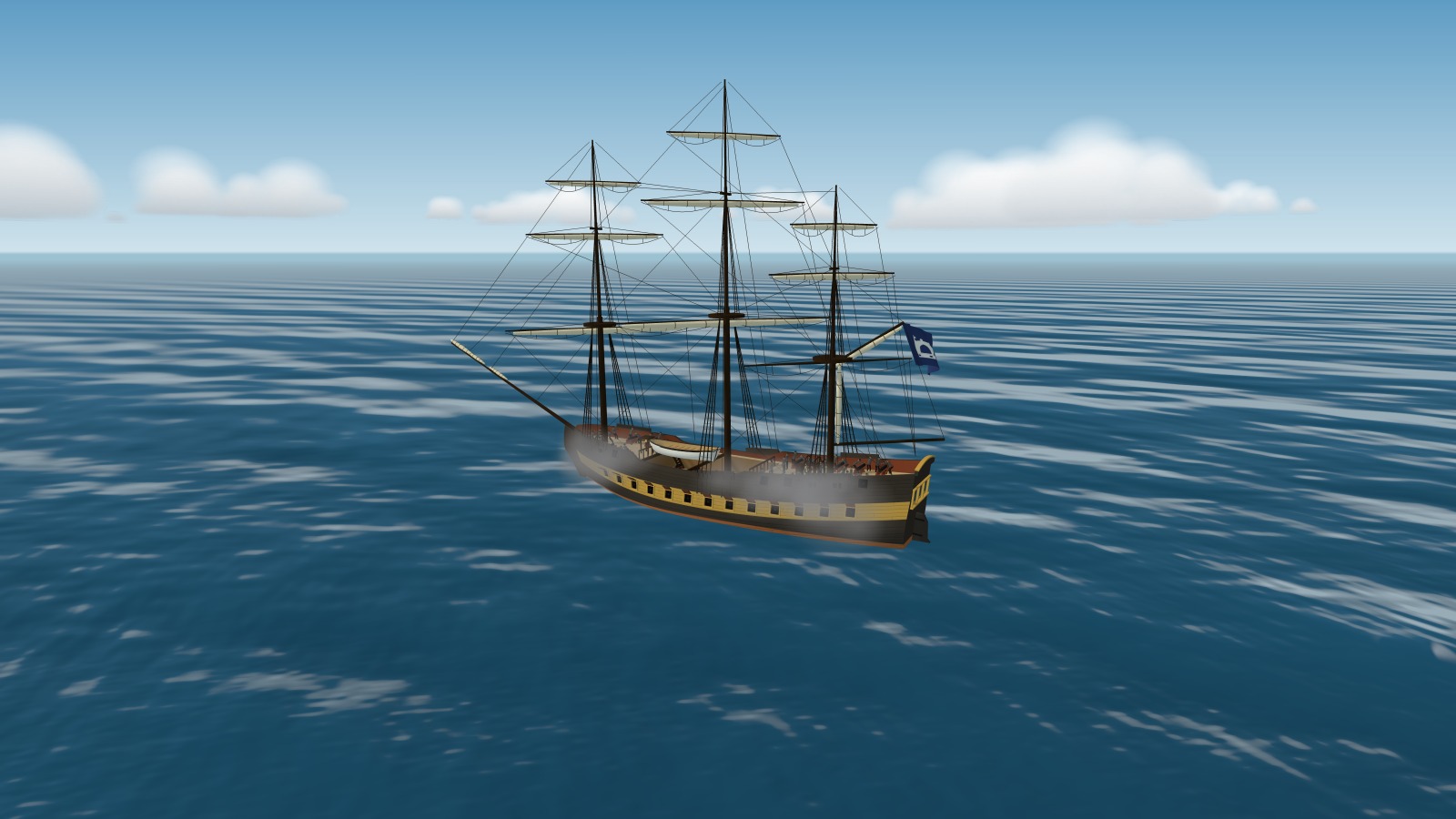
A ship's guns fire on the beam. Each gun can traverse 30 degrees forward or aft of square, so a broadside covers a sector of 60 degrees out from each side and nothing ahead or astern. To fire, you put the enemy in that sector: the whole art is in the sailing.
With a side's order at Fire at will, each loaded gun fires on its own once an enemy is in its arc and in range. It fires a moment after bearing, almost a second on average, so a broadside ripples down the side rather than going off at once, and the guns fall out of step as they reload. A gun picks the nearest enemy it can bear on. It never fires on a ship that has struck, a ship's boat, or anything behind land. It holds fire while a ship of your own side fouls the line of fire.
How the guns are laid
Each gun is laid on the part of the enemy abreast of it, about halfway up the side, so a broadside spreads along the target's length instead of piling into the middle. The guns are aimed where the enemy is when they fire, with no allowance for its movement. A ball flies at about 250 metres a second, which is a little over a second to 300 metres and two seconds to 500, so against a fast ship crossing at long range, the shot lands well aft of where it was laid, and some of it misses astern. Your own ship's speed carries into the ball. Every shot scatters a little, more at long range, which is why fights are won close in.
Range
The guns elevate up to 5 degrees, which sets the most a shot can carry. The figures are about the same for every ship:
| Shot | Greatest range |
|---|---|
| Ball | about 1,150 m |
| Chain | about 750 m |
| Double | about 600 m |
A gun won't fire at an enemy beyond its shot's range, so loading chain or double at long range means holding fire until the enemy closes.
Reloading
Guns start every engagement unloaded. A gun's reload time depends on its shot, with the full gun crew at the side:
| Gun | 6-pdr | 9-pdr | 12-pdr | 18-pdr | 24-pdr | 32-pdr |
|---|---|---|---|---|---|---|
| Reload | 84 s | 89 s | 93 s | 102 s | 111 s | 123 s |
With half the gun crew, because both sides are fought, a gun takes about twice as long. Casualties slow it further. See Crew and Stations.
A side that is stood down keeps its load, so you can load a broadside, stand it down and still have a full broadside ready when you man it again.
Ball, chain and double
Ctrl+[ and Ctrl+] step a side's shot through ball, chain and double. The small button on a gun side does the same. Changing the shot makes the guns already loaded draw their load and reload with the new shot, so change before a broadside, not just after one.
- Ball: the longest range and the standard load. It kills men aboard and does nothing to the rigging: a ball through the sails flies on.
- Double shot: two balls at a reduced charge. Barely half ball's range, but each hit kills nearly twice as many. A close-range load.
- Chain shot: two half-balls joined by a chain, slower and wilder than ball. It's laid on the rigging rather than the hull, and it tears the sails and weakens the masts. It kills few men.
What a hit does
Damage in Quarterdeck is to the crew, not the hull. A ball that strikes within 60 degrees of square to the side goes in; one that strikes more glancingly bounces off and leaves a gouge. A ball that goes in kills along its path through the ship, more for heavier shot. Through the side, an 18-pounder crossing a frigate's deck kills about one man.
That is why raking matters. A ball fired in through the bow or the stern travels down the whole length of the ship, and kills about three times what a beam hit does. Crossing an enemy's bow or stern, where its own guns can't bear on you, is the strongest position in a fight.
Every man lost slows the enemy's guns and sail handling and costs the ship morale. When its morale is gone, it strikes: see Morale and Striking.
Chain and masts
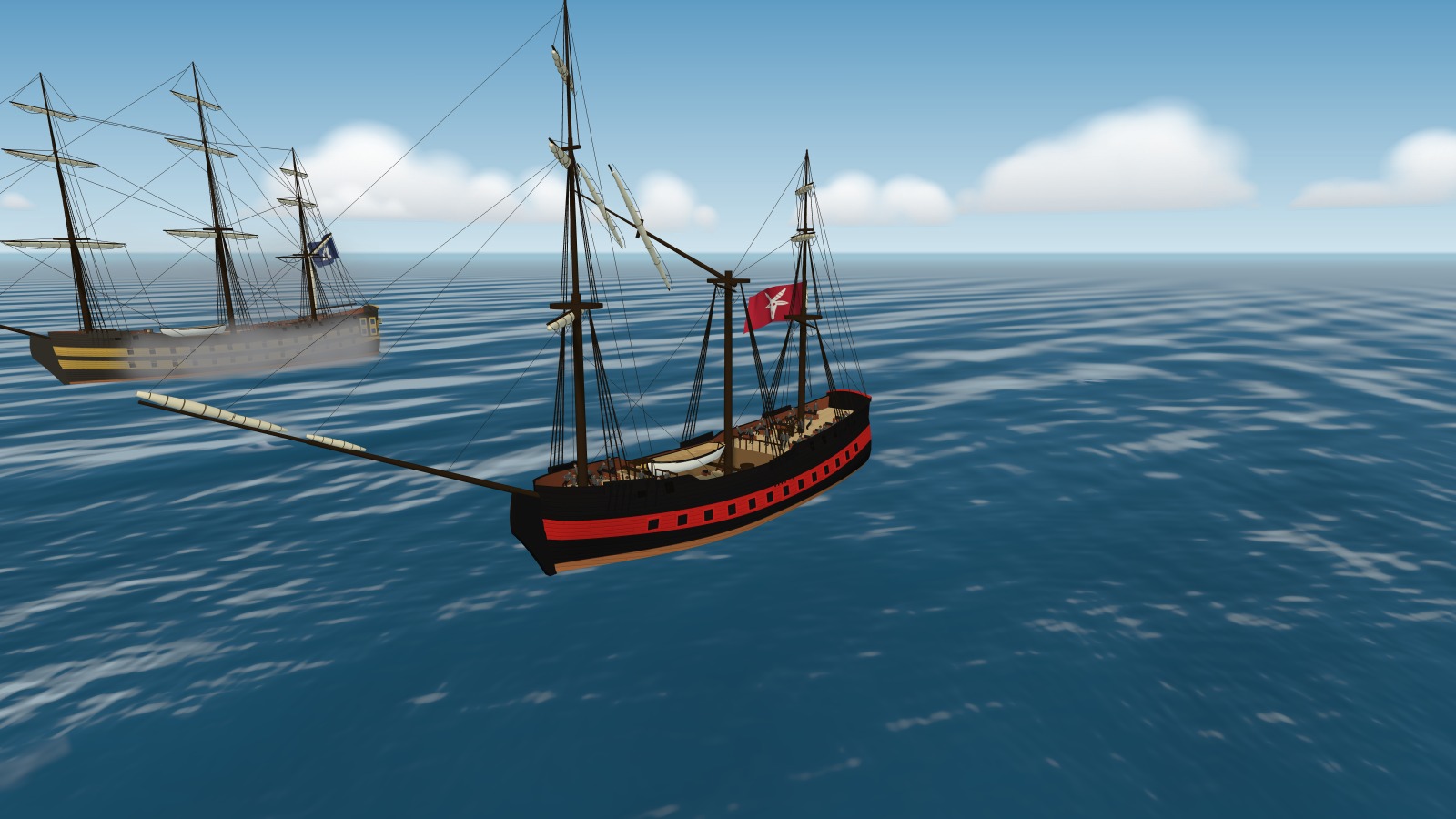
Every chain gun in a broadside is laid on the same mast: the one already most damaged, or on an untouched rig, the one nearest you. So masts come down one at a time. Each hit tears that mast's sails, which costs the ship drive, and weakens the mast. A mast that goes over the side takes its yards and sails with it and costs the ship a quarter of its morale. A ship without its foremast, say, loses the drive and the turning of the fore yards. A first rate's chain fired into a frigate brings down the first mast in about two minutes.
The tally
In an engagement, a tally at the top of the screen counts your ship's shot as it lands: misses, hull hits and rigging hits.